Relatable life lessons from a 1000 year old text
‘Now begins the heart of the teachings on recognition’
The Recognition Sutras (Pratyabhijñā-hṛdaya) is a beautiful, life affirming and incredibly reassuring text on awareness, remembrance and an all-pervading effulgent universal consciousness.
The author, Kṣemarāja, didn’t write this text for elites and academics, he wrote it for any and all spiritual seekers. It’s intentionally concise, serving as an introduction to Recognition philosophy for everyday folk of the time and in particular, “for rare devotees whose minds are childlike.” It offers deep wisdom for curious people and is continuously relatable, despite the 1000 years and cultural differences between readers today and its original audience.
I’ve spent the last 6 months studying this text with my inspiring teacher Paula Andreewitch as part of her Tiny & Vast training. Our Monday philosophy study sessions have been mind bending (in the very best way!)
Paula teaches what could be quite a ridley-text in the most accessible way - bringing these words to life in a way that feels so relevant to everyday life. In homage, here are 5 relatable lessons that have resonated with me from the 1000 year old masterpiece.
It’s worth noting that this copy of the text is also presented with commentary from Christopher Wallis, whose reflections, insights and experiences have no doubt impacted the way in which the words are understood. He begins the commentary by suggesting an intention for study:
“Take the sutras deep inside and let them marinate; let them work within you. Come at them from every angle. Hold them up to your own experience. Explore the feelings, the textures, the colours and the flavours of the teachings. Ask yourself again and again, what would it be like if I directly realised the truth of this teaching? What might it feel like to abide in the wordless place this teaching arose from.”
1. Life is always unfolding through you
You are not separate, apart or distinct from the world around you. You are not a distant voyeur but you are constantly and inseparably co-creative in the dance of life.
In the text, this life force is described as being Awareness, or sometimes more specifically the Goddess Awareness. She is said to be “free and independent, the cause of the performance of everything.”
We might consider this force as ‘the one’. It’s the background, or ground of being, from which all life, seemingly spontaneously, emerges from and also dissolves back into.
Your embodied experience, just like the experience of all animal and plant life around you, is the manifest form of that underlying ground longing itself towards self expression.
To feel this teaching is to become immersed in the fabric of the world. It’s to recognise that we are both the blue sky and the clouds that move through it, both the sea and the waves. In a culture that has become more surreally fragmented and distanced there can be nothing more powerful.
2. You don’t need to transcend your body to feel the divine
This text was written in direct response to previous philosophies and practices of the time which valued the renunciate path to liberation. In these frameworks, the body can feel like a problem to control, with the senses often described like wild animals to be tamed.
From this non-dual framework, the earth, elements, body, sense objects, intelligence, desire, knowledge, agency, reflective self awareness and the transcendent light of consciousness are said to be manifestations of the same Awareness, just presenting itself in varying forms and densities. Importantly, there’s no hierarchy here and each density (known as Tattvas) informs the others.
“So in reality, there is no subject or object whatsoever that is other; rather, it is simply the revered Goddess Awareness that is vibrating thus in thousands of different forms.”
How freeing to consider our direct, felt experience as a way to know consciousness itself. Practically, you may have experienced this in your own practice as moments of bliss, connection and wordless recognition.
3. The pattern of the whole is contained within it’s parts
Uniquely for the philosophies of the time, Awareness is described in this text to have a desire towards emergence. Life is said to be the acting of that desire, the ground of being materialising into form in order to experience itself.
“The individual conscious being, as a contraction of universal Awareness, consists of the entire universe in a microcosmic form.”
For me, this completely resonated with the felt sense I experience when practising yoga and meditation. A remembering, an integration and a homecoming to the bigger picture.
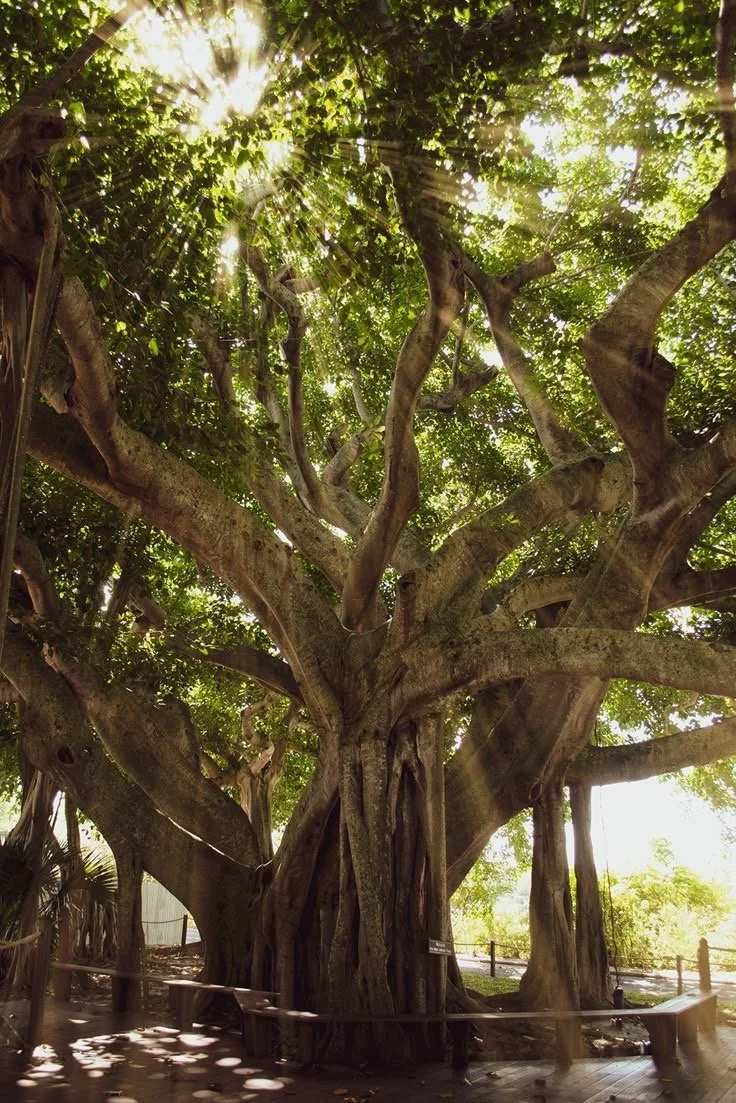
The text goes on to describe the analogy of the banyan tree, where the seed of the entire ecosystem is contained within the smallest of seeds. There it is, the pattern of the whole is contained within the part. Much like our embryological experience where the whole is contained within the single egg, which goes on to emerge, unfold and multiply all while never losing its wholeness. You are a living experience of this philosophy.
4. You can be in a state of noticing life, or not
Why does our wholeness seem harder to access in some moments than others? I can register intellectually that I am an expression of Awareness itself, but sometimes I feel distant, confused or just a bit numb. The text has an answer for this too.
“In the same way, He performs the Five Acts even on the level of saṃsāra, in the form of one whose Power of Awareness is contracted.”
Kṣemarāja suggests five acts through which life, experience, thoughts and feelings are constantly circling.
The first, a state of emergence. The second, a period of sustenance. The third, an experience being dissolved or returning to the bigger picture.
The fourth act is a state of not-noticing, contraction or concealing. We are distant, singular and unaware that we are even thinking, feeling, breathing. Realistically, this is the place we spend so many of our days in.
The fifth act describes a state in which we are noticing the first three acts in process. We are aware that we are aware and able to digest experiences. In mindfulness speak, we might call this being present.
The final two acts cannot exist together, but instead move in and out as a process of noticing or not noticing. Yoga and meditation present invitations to come into that place of noticing a little more often, receiving the joy of Awareness in return.
5. Life leaves impressions on you, but also presents opportunities for them to be digested
When we contract from our experiences they can be left undigested. Much like the trauma held in the body in the writings of Bessel van der Kolk, a trace of unfinished business can be held tightly and carried for years. This is known in the philosophy as a saṃskāra or impression. Christopher Wallis explains in the commentary:
“Whenever we turn away, even partially, from what is happening in the present moment because it is too uncomfortable, too painful or even too wonderful, it creates a saṃskāra.”
As much as experiences, both pleasurable and painful, leave impressions on the body, we are also presented with invitations for them to be resolved or released, under the right conditions.
Kṣemarāja’s original text continues:
“However, when something that has been internally deposited in this way … becomes one with the Fire of Consciousness through the process of ‘sudden digestion’, also known as the method of ‘total devouring’, then it is said to be graced, because it has been integrated into the state of complete fullness.”
I love the word digested here because it doesn’t imply letting go of your problems like it’s easy, but instead suggests there’s chewing to be done. Although this is no doubt the longer path, it is surely the most rewarding too. This is also never something that’s finished or completed, but a constant act of showing up actively in our lives, angling towards the present and allowing ourselves to be moved by it again and again.
-
Thank you Paula Andreewitch for sharing your studies, interpretations and insights on this text in Tiny & Vast Phase 2. Paula is a teacher that can somehow make yoga philosophy incredibly entertaining and also very real. This second read has revealed wonders and sharing these reflections here has been a chance for me to attempt to communicate the things that have landed with me the deepest, in the simplest way.